Recently, the Animal Schistosomiasis Research Team of SHVRI CAAS published a spotlight article focusing on the mechanisms underlying male–female pairing and reproductive development in schistosomes, systematically explaining the critical role of the male reproduction-associated neural network in regulating female reproductive maturation. The article was published in Trends in Parasitology.
As dioecious parasites, schistosomes require sustained pairing between males and females for the development and maturation of the female reproductive system. This unique phenomenon has long been an important scientific question in parasitology. The article points out that male regulation of female reproductive development depends on an intact reproduction-associated neural network.
The study highlights a male-specific neuronal subpopulation, N4.3, in Schistosoma japonicum. This subpopulation is located in the gynecophoric canal and is capable of synthesizing and releasing the pheromone β-alanyl-tryptamine dipeptide (BATT), thereby promoting the development of the female ovary and vitellarium. The study further shows that the limbic system-associated membrane protein LSAMP plays a key role in maintaining axonal integrity and synaptic stability in this neural network. When lsamp is disrupted, the structure of the male neural circuit is damaged, accompanied by reduced vitelline gland maturation and egg-laying capacity in females. These findings suggest that male regulation of female reproductive fate is essentially a reproduction-regulating mechanism driven by “neural wiring.”
This study expands current understanding of male–female interactions in schistosomes and provides a new neurobiological perspective for understanding the coordinated evolution of sexual reproduction in parasitic organisms. These insights also provide a theoretical basis for further dissecting schistosome reproductive mechanisms and identifying new targets for interfering with parasite reproduction and transmission.
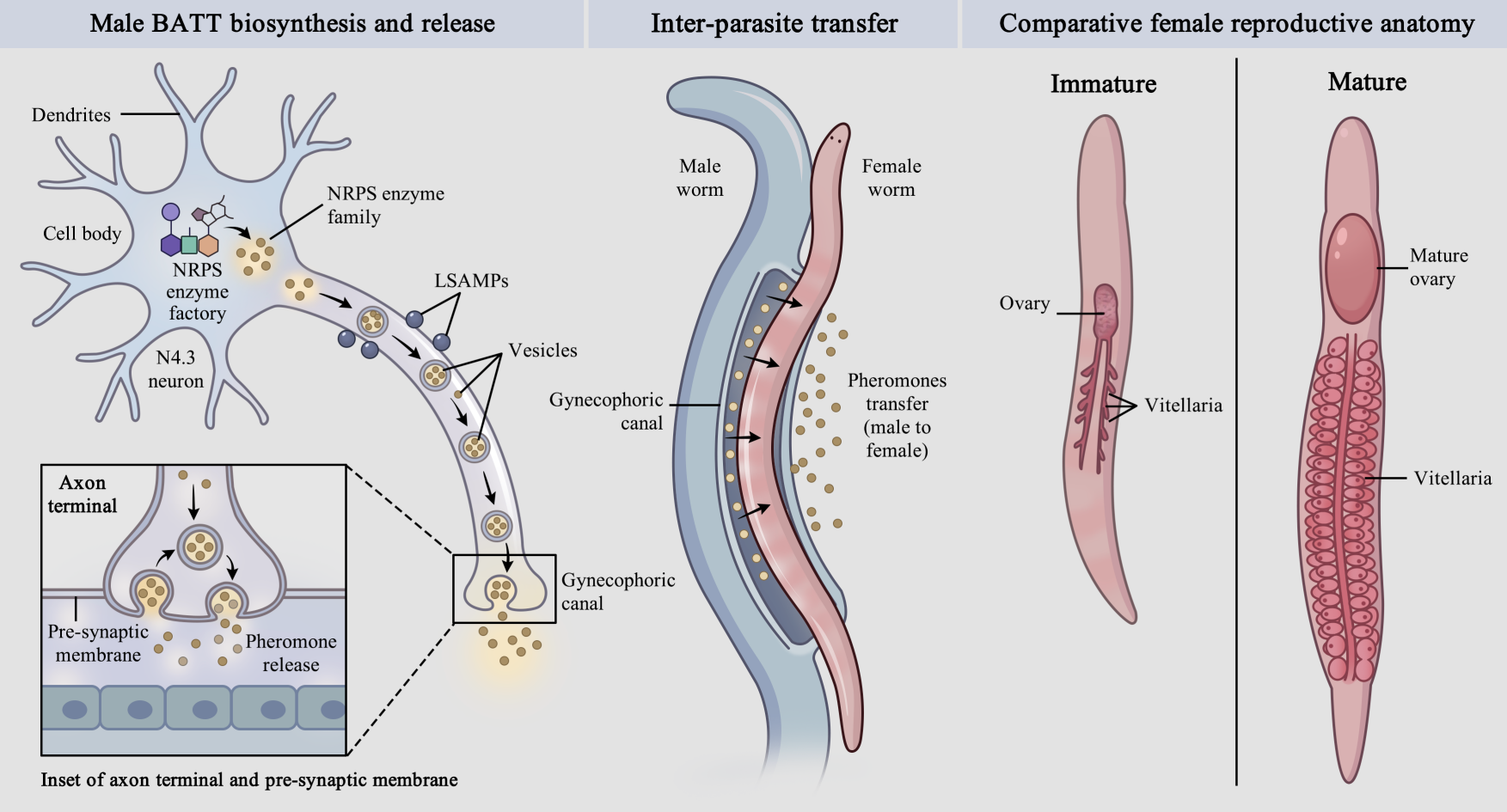
Schematic illustration of pheromone release mediated by the male neural network regulating female reproductive maturation in schistosomes
Assistant Researcher Haoran Zhong of SHVRI CAAS, is the first author of this paper, and Professor Yamei Jin is the corresponding author. This work was supported by the Shanghai Sailing Program and the Agricultural Science and Technology Innovation Program of CAAS.
Original article: https://www.cell.com/trends/parasitology/fulltext/S1471-4922(26)00071-1