The Innovation Team of Food Safety Research of SHVRI CAAS, has achieved great progress in the rapid diagnostic detection of Pasteurella multocida. The team successfully developed a dual-mode, one-pot isothermal amplification platform based on the CRISPR/Cas12b system, integrating fluorescence detection and lateral flow strip readout. This platform enables highly sensitive and specific detection of P. multocida. The related research has been published in the international journal Letters in Applied Microbiology.
Pasteurella multocida is an important Gram-negative bacterial pathogen that can infect poultry, pigs, cattle, sheep, and humans. It causes severe diseases such as fowl cholera, swine pneumonia, and hemorrhagic septicemia in cattle, leading to substantial economic losses in the global livestock and poultry industries. Traditional pathogen isolation and culture methods are time-consuming and require specialized laboratory facilities, making them unsuitable for rapid diagnosis in field or primary-level settings. Therefore, developing a rapid, simple, and accurate nucleic acid detection method is essential for early diagnosis and epidemic monitoring of P. multocida.
This study focused on integrating and optimizing the trans-cleavage activity of the CRISPR/Cas12b system with loop-mediated isothermal amplification. The research team introduced sodium heparin as a novel regulator of Cas12b cis-cleavage activity. Sodium heparin effectively inhibited Cas12b-mediated cleavage of the template during the amplification stage, thereby enabling the sequential integration of LAMP pre-amplification and CRISPR-based precise detection in a single closed tube. This design overcomes key limitations of conventional two-step assays, including complicated operation and the risk of aerosol contamination.
Based on this strategy and the highly conserved P. multocida-specific gene KMT1, the established detection platform showed excellent performance. The detection sensitivity reached 5.0 × 10¹ CFU·mL⁻¹, and no cross-reactivity was observed with 21 non-target bacterial strains, indicating 100% specificity. In addition, the platform was validated using artificially contaminated milk samples. The results demonstrated that the method maintained high sensitivity even in complex clinical sample matrices, highlighting its great potential for clinical and field application.
Unlike conventional systems that rely on complex physical separation, this platform achieves one-pot CRISPR/Cas12b detection of P. multocida through biochemical regulation by sodium heparin. By combining fluorescence detection with lateral flow strip readout, the method not only reduces operational complexity and minimizes contamination risk, but also balances laboratory-level accuracy with the convenience required for on-site testing. This sodium heparin-regulated one-pot CRISPR/Cas12b isothermal detection strategy provides a powerful tool for rapid field diagnosis of P. multocida and offers a broadly applicable approach for the development of nucleic acid detection kits targeting other pathogens.
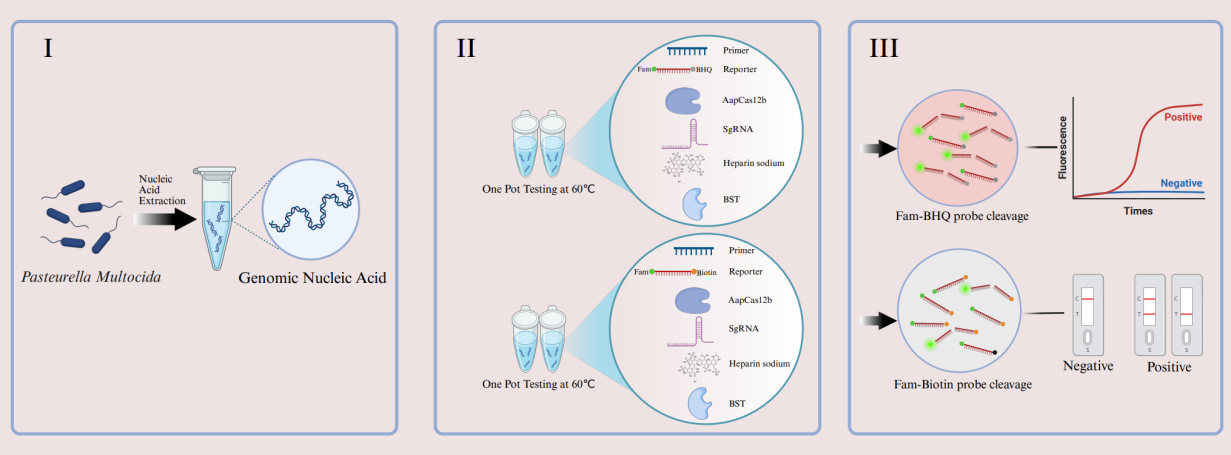
Workflow of the dual-mode rapid detection platform for Pasteurella multocida.
This study was completed by Ningyuan Zhong, a jointly trained doctoral student of the SHVRI CAAS, and Nanjing Agricultural University. Professor Xiangan Han and Professor Zugong Yu served as the corresponding authors. This work was supported by the National Key Research and Development Program of China, the Fujian Science and Technology Plan Foreign Cooperation Project, and the Shanghai Agricultural Applied Technology Development Program.
Original article DOI: 10.1093/lambio/ovag044