Recently, an inovation research team of SHVRI CAAS has systematically delineated the molecular mechanisms underlying Newcastle disease virus (NDV)-mediated manipulation of the host autophagy system to regulate viral replication and cell fate determination. These groundbreaking findings have been published in two consecutive articles in the prestigious journal Autophagy.
Research Background
Autophagy serves as an intracellular self-cleaning and recycling system, playing a critical role in maintaining cytoplasmic material turnover and homeostasis. As an oncolytic virus, NDV exploits this "cleaning" machinery to promote its proliferation. However, the mechanisms by which NDV regulates the functions of distinct organelles through selective autophagy have remained unclear.
Research Advances
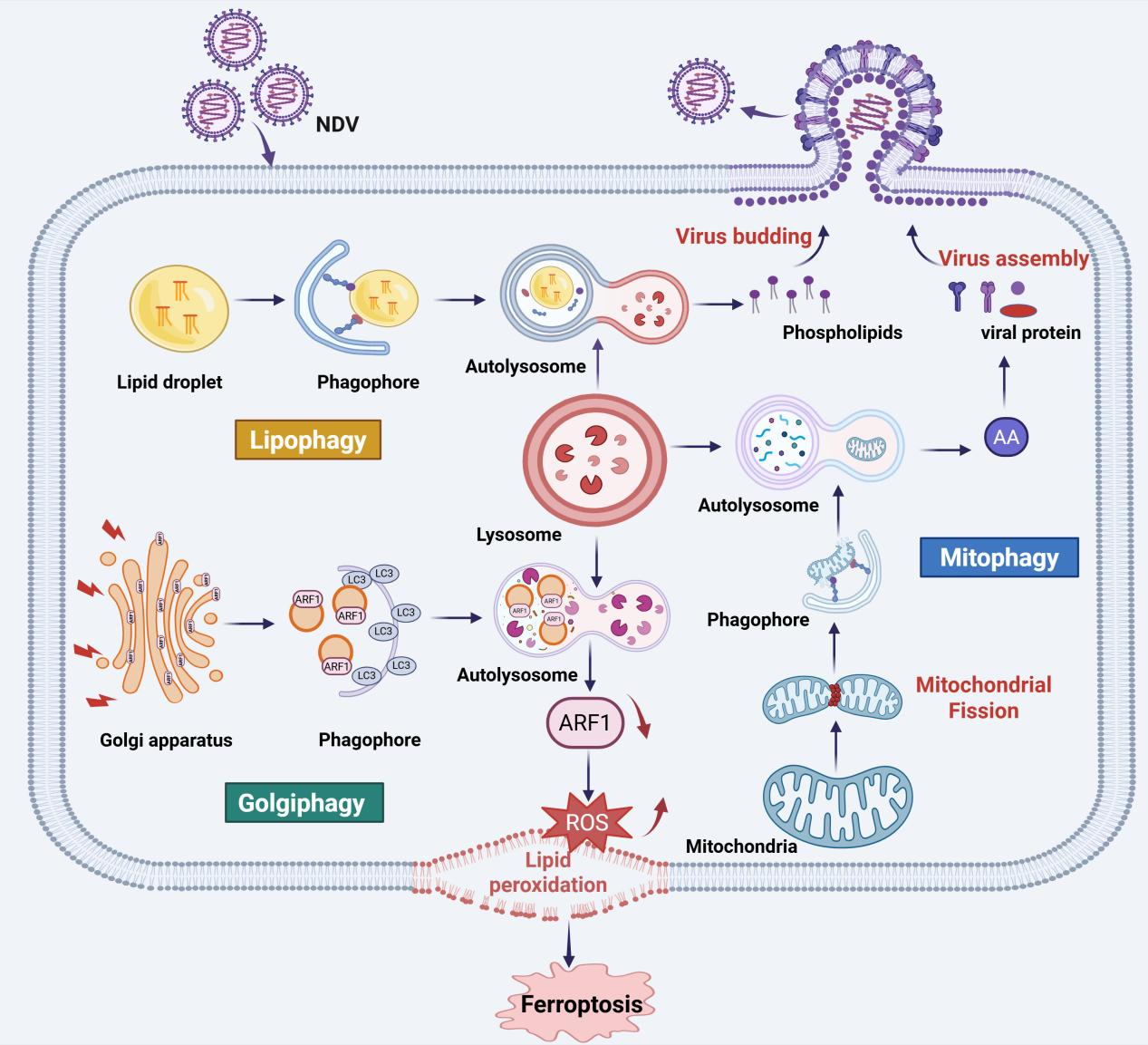
A series of studies have revealed that NDV manipulates the functions of multiple organelles through a process termed "pan-organellar autophagy." Specifically, the virus induces selective mitophagy, which leads to the accumulation of free amino acids in host cells, thereby providing building blocks for viral protein synthesis and genome replication. It also triggers lipophagy, mobilizing unsaturated fatty acids for the synthesis of the viral envelope, thus facilitating progeny virus budding and release. Furthermore, the virus activates Golgi stress and induces autophagic degradation of the Golgi apparatus, disrupting redox homeostasis and ultimately driving cells toward ferroptosis.
Collectively, these findings offer novel theoretical perspectives for understanding the mechanisms underlying efficient viral replication and oncolysis, and also identify potential targets for the development of novel antiviral and anti-tumor therapeutic strategies.
Funding
This work was supported by the National Natural Science Foundation of China (Key Programs and Key International Cooperation Projects) and the National Key Research and Development Program during the 14th Five-Year Plan.