Recently, the Prevention and Control Techniques for Porcine Viral Reproductive Disorder Epidemic team of SHVRI,CAAS has made significant progress in elucidating the pathogenic mechanisms of classical H1N1 subtype swine influenza virus (CS H1N1). The team discovered that the combination of the PB2-D740N and PA-T97I mutations in classical H1N1 subtype swine influenza virus enhances its pathogenicity both in vivo and in vitro, providing crucial information for assessing the epidemic risk of swine influenza virus strains. The findings were published in Emerging Microbes & Infections.
The classical swine H1N1 influenza virus was first isolated in 1930 and crossed the species barrier to infect humans. However, whether the CS H1N1 will enhance its pathogenicity in humans after undergoing adaptive evolution within mammalian hosts remains inconclusive. They explored the impact of mammalian adaptation on the pathogenesis of CS H1N1 virus by performing 13 blind serial lung-to-lung passages in mice, and a mouse-adapted (MA) H1N1 virus (A/Swine/Guangdong/1/2011[G11-MA]) with increased virulence was obtained. Further analysis revealed that the G11-MA strain contained the amino acid mutations PB2-D740N, PB1-T56I, PA-T97I, and HA-K188E, and the combination of PB2-D740N with PAT97I improved the replication ability in mammalian cells and mice. Protein structure analysis revealed alterations in both the number and length of hydrogen bonds within a 5 Å radius around the PB2-D740N mutation site. The study demonstrates that the combination of PB2-D740N and PA-T97I plays a key role in the virulence phenotype of CS H1N1 influenza viruses, and provides important information for evaluating the pandemic risk of swine influenza strains.
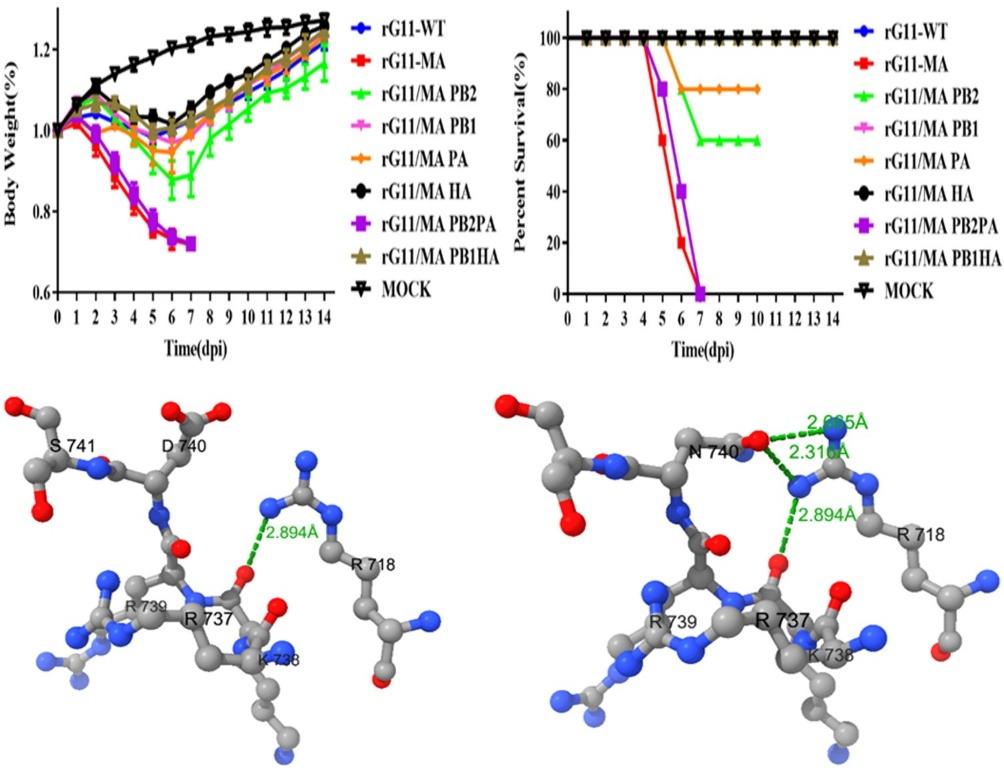
Molecular pathogenesis of classical swine H1N1 influenza virus
This study was supported by the National Natural Science Foundation of China, and Natural Science Foundation of Shanghai.
Original link: https://pubmed.ncbi.nlm.nih.gov/41362174/.